Mean cost of a healthcare breach
0
The most expensive of any sector — IBM Cost of a Data Breach (2024).
Utopick IT protects hospital networks, patient portals, and connected medical devices from the threats that interrupt care and start a breach clock — with BAA-capable architecture and audit-ready evidence from day one.
Cyber defense in healthcare has stopped being discretionary spend — it is the operating permit that lets a provider keep treating patients.
The most expensive of any sector — IBM Cost of a Data Breach (2024).
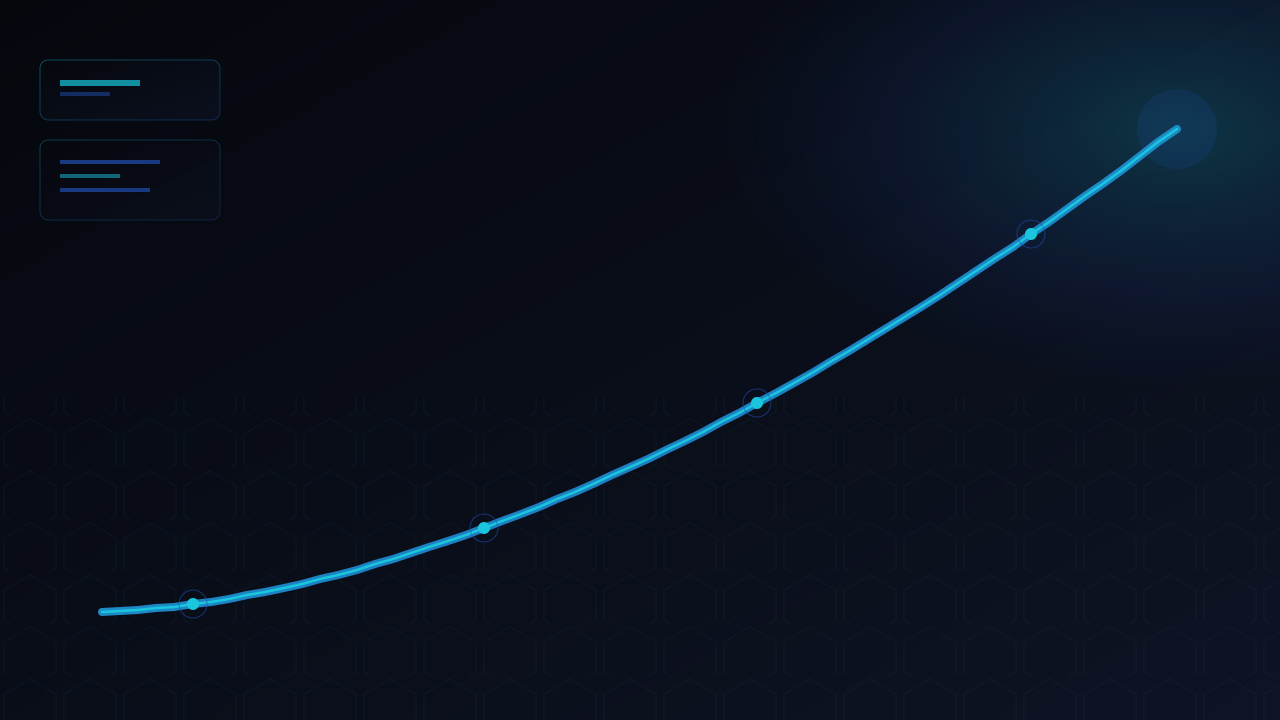
Forecast — rising from roughly $13B today at about 18% CAGR through 2030.
Ransomware cases reported against US hospital systems each year.
A ransomware hit on a hospital is today a patient-safety event. HHS OCR fines grow with severity, while new state statutes keep stacking disclosure duties on top of HIPAA.
Healthcare buyers want predictable fixed pricing packaged with BAA coverage — the shape that hospital IT actually buys.
Eight intertwined risks — each one interrupts care, starts a HIPAA breach clock, or does both at once.
Bulk theft of patient records — the data that fetches the most on dark-web markets.
Locked EHRs push ambulances elsewhere, scrub surgeries, and degrade ICU care.
Credential-stuffing runs at MyChart-class portals.
IoMT gear — infusion pumps, MRI units, monitors — abused as a way onto the network.
Staff peeking at celebrity, colleague, or family charts.
A breached contractor or clearinghouse opening a door in (Change Healthcare 2024).
Tailored spear-phishing aimed at doctors and billing teams.
Operational outages that carry documented patient-safety consequences.
Utopick IT works inside the fast-growing healthcare cyber segment, providing a single detect-respond-and-evidence layer made to protect clinical systems, record what happened, and keep pace with HIPAA breach clocks.
“In healthcare, cyber is patient-safety work. The right partner delivers detection and the breach-notice paper trail an examiner will accept.”
Utopick IT pairs performance metrics with a capped monthly fee that includes BAA coverage.
A flat monthly fee with BAA included — no surprise per-event charges.
Performance metrics delivered each quarter to compliance and the board.
A single contract can span one hospital, an entire system, or a regional health network.
Built for BAA-bound deployment — minimum-necessary access enforced out of the box.
One engine fits the hospital CISO, the ambulatory IT director, and the payer compliance lead.
Every billable event carries an audit chain — the moment HHS OCR or a state AG calls, the record is ready.
Five pillars on one engine — the package a hospital CISO and Privacy Officer end up buying together.
HHS OCR had flagged minimum-necessary access weaknesses after a celebrity-record snooping incident. Hospital leadership was equally worried about a clinician-MFA rollout that previously slowed an academic medical centre's ED throughput by 3%.
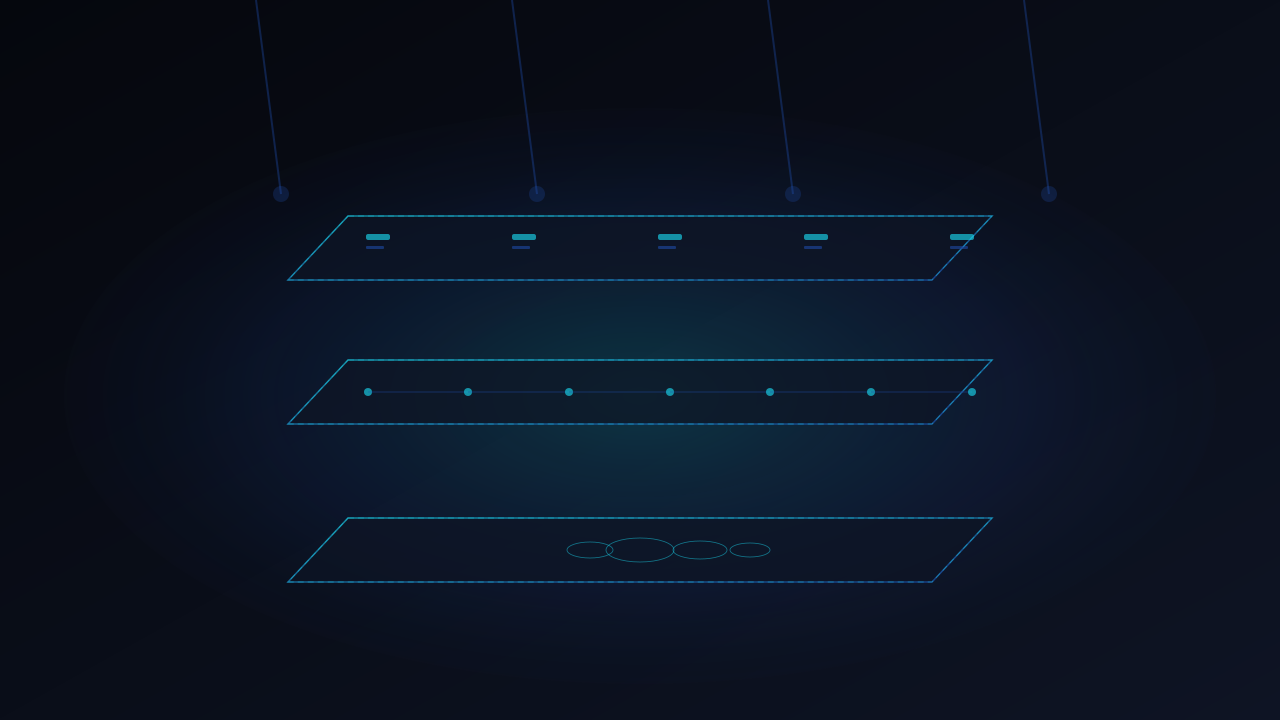
Each relevant event passes through six layers working together in under two seconds.
Establish who is reaching the record — patient, clinician, billing staff, or contractor.
Judge, in real time, whether the access is legitimate.
Halt the payload at the door of the patient portal and the clinical app.
Determine whether the source is already flagged as hostile.
The CIO and Privacy Officer cockpit — and the platform’s reporting engine.
Assemble the notification package that HHS OCR, the state AG, and affected patients will receive.
Documented patient-safety events fuel insurer pressure and board-level mandates.
Each connected medical device is another way onto the network.
Both the count of penalties and the severity per violation climb year over year.
Texas, California and others pile extra disclosure duties on top of HIPAA.
Model-risk governance now reaches clinical-AI vendors.
Note. Scope, deliverables, timelines, and SLA tiers are agreed in a mutual Statement of Work. Commitments on this page are illustrative; binding terms live in the engagement contract.
PHI runs on a BAA-capable architecture — encrypted at rest and in transit, governed by role-based minimum-necessary access, and logged in hash-chained access trails.
The architecture is built for BAA-capable deployment with HIPAA-aligned controls. Formal HITRUST certification sits on the roadmap; its timeline is covered under signed deal-room access.
A fixed monthly fee with BAA included. Performance metrics are reported each quarter. Multi-year contracts use floor-and-cap structures.
Mid-market US hospital systems, regional health networks, ambulatory groups, and payers. Tier-1 academic medical centers through partner channels.
We commit to measurable improvement over your baseline — quantified for each engagement in the Statement of Work. SLA-backed commitments with clear remedies, not vague guarantees.
A scoping call within 2 business days. A signed Statement of Work usually within 7–14 days. Monitoring goes live within 30 days of the SOW for standard engagements; an emergency incident-response retainer can be switched on within 24 hours.
Most of the work is delivered by analysts and engineers we employ directly. Where a vertical calls for specialist coverage (forensics, firmware analysis, jurisdiction-specific filings), the named partners are disclosed in the SOW ahead of signature — never quietly white-labelled.
We fit into your existing clinical-security stack instead of replacing it. Our team runs the operating layer above the tools you have already bought — clinician MFA, IoMT visibility, breach-notice drafting, HHS-OCR-ready evidence. If a tool is truly falling short of BAA expectations, we put that in writing.
Region-specific options — EU, UK, US, Israel, GCC — are scoped per engagement. A BAA (US healthcare), a DPA (EU), and ISO 27001-aligned controls are issued under the engagement contract. Production data and PII never leave your designated region without written consent.
After the first scoping call, under mutual NDA. Most of our clients are regulated and are contractually barred from being named publicly. Reference calls with comparable-size buyers in your vertical are set up before the SOW is signed.